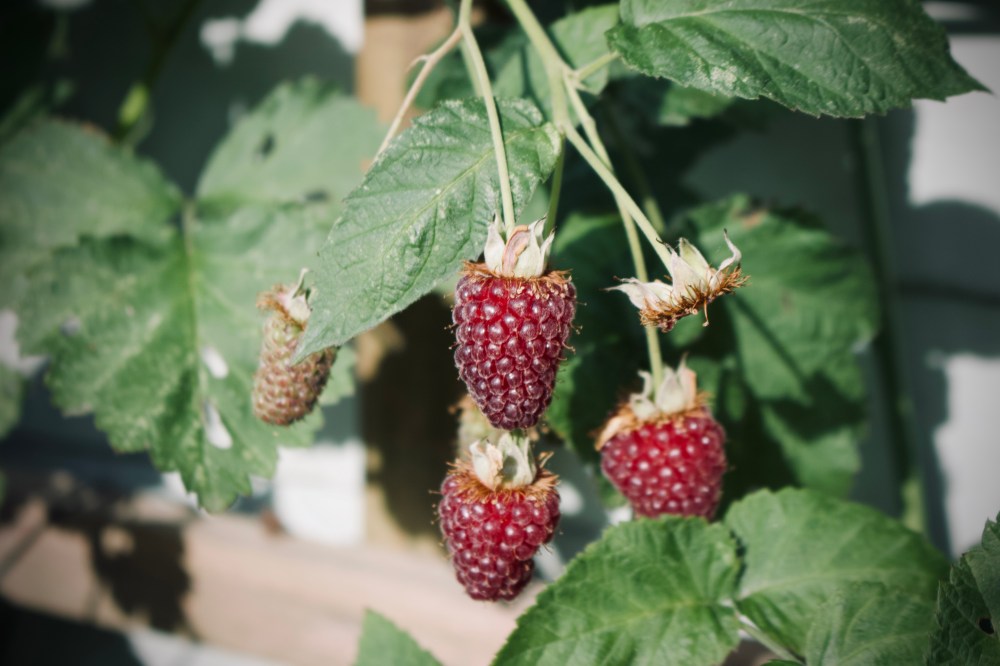
One of the joys of this time of year is finding the little maroon gems of Tayberry Buckingham hiding in a secluded part of my garden. A cross between a raspberry and blackberry, the Tayberry was developed in 1979 by Derek Jennings of the famous Scottish Research Institute and is named after the Scottish River Tay. Buckingham is the thornless variety. Tayberries get the colour and a lot of the flavour from raspberry but the size and bite from the blackberry. You will not often see them in supermarkets due to their softness which makes them difficult to pick and store commercially so if you want to try them you will need to grow your own.
Tayberries like a sunny spot but will tolerate shade. They grow to 2 meters tall and wide with a lax habit and are best trained in to a fan, either against a fence or wall or on wires.

In the Kitchen
Picked when fully ripe, a deep maroon colour, tayberries are similar in flavour to raspberries. You can eat them fresh with a little sugar, they also make excellent jams, crumble or pie fillings, blended in to a fool or lightly crushed for ice cream or meringue toppings. They freeze well.
Yield and plant health
Generally Tayberries are issue free and easy to grow. As the canes are quite soft and floppy they do benefit from training which has the advantage to lifting the berries up for easy picking. A fully grown push could yield up 1.3kg of fruit between June and August.
Suppliers
Fairly common on online suppliers but you might struggle to find in your local garden centre.

Growing
It is best to plant tayberries during their dormant period which would be October to February. Plant tayberries 2.5 meters apart. Before planting prepare the ground by digging plenty of well rotted manure or compost where you are to plant and get your support system in place. Types of support could be a trellis fixed to a fence or wall or a post and wire system. For a post and wire you will need posts 2.5m high set 2.5 m apart. Drive the posts firmly in to the ground ensuring they are secure and level. Stretch 12 gauge galvanised wires between the posts every 60 cm up using turnbuckles or similar to create tension on the wires.
When your tayberry arrives, dig a planting hole the same size at its current pot or large enough to easily contain the roots if you have bought a barerooted plant. Plant the tayberry to its current planting depth, firm in and water well.
Tayberries fruit on last years growth so when the canes have fruited cut those canes down to the ground and tie in new canes for next years berries.
The plants will benefit from a good mulch in early spring and watering if there is a prolonged dry spell.
 Tabula Rasa